

moonmilk
the ecological function of Cancer

This month’s essay continues the exploration of the ecological functions of the zodiac. What are the essential natures of the signs? Where do we see their qualities appearing in nature? What necessary roles do they play in our wider ecologies? This month’s post on Cancer is the tenth in the series; the rest of the series can be found here.
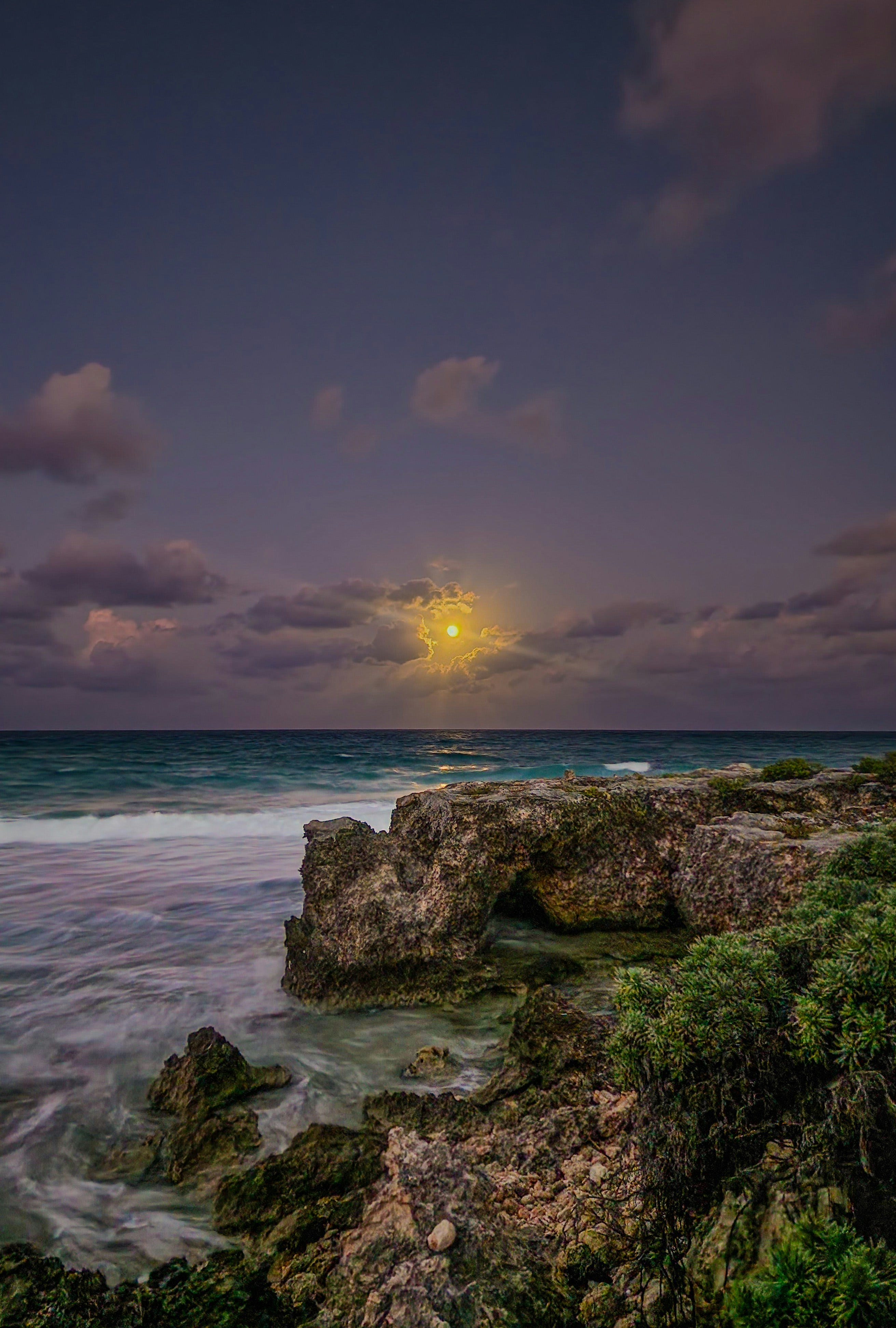
Cancer: the astrological tide pool; the gateway of mankind. As tide pool, Cancer might be seen as the gateway of all life. She is the Ocean of Milk, churned by the devas and asuras in Hindu cosmology, producing many life forms and blessings in addition to the amrita, the nectar of immortality. Cancer is the mineral-rich ferment of contemporary scientific myth, out of which life first spawned.
Do I even need to make a case for this one?
But more than what the zodiac signs are, these essays probe into why and how they express the way they do, from an ecological perspective. Cancer, as a tide pool, only gives the illusion of shallowness. The proliferation of life forms visible—crabs, sea urchins, clusters of barnacle—deceive us into thinking we’ve seen all there is to see. But what about those things invisible to the eye? For the sake of those hidden things, let’s see if we can’t go a bit deeper.
the essential nature of Cancer
We’ll start by unpacking the basic qualities of this sign, which are made up of:
its ruler, the Moon, goddess of the sublunary sphere and all things fleshly, changeable, and impermanent (and in this essay, you’ll see me using the moon and Cancer interchangeably; that’s because Cancer is the sole sign of the moon. The sign of Cancer expresses the full complement of the moon’s qualities, so we might consider them to be essentially synonymous)
its gender, feminine: process oriented, receptive and selective
its element, water: fluid, emotive, instinctive
its modality, tropical, or turning: at the headwinds of change
Whatever your background in astrology, reading through that list of elements I’m sure you can feel just how archetypal the sign of Cancer is. Sure, I could attempt to break this sign down for you; or, I could ask you if you remember the last time you saw the moon. Whatever you felt in that moment, whatever catalogue of feelings you’ve felt in all of your years spotting the moon, therein lies everything you’ll ever need to know about Cancer. Anything additional is an abstraction. But for the sake of clarity, and for the purposes of this essay, let’s go ahead and wax poetic for a moment.
See, the thing about Cancer is this: you can’t talk about this sign without talking about literal ecologies, the literal ocean, literal animal bodies alive here on earth. The currency of the moon is water, of which our bodies are made up by about 60%. This is not a metaphor. The phasal dynamics of the moon maintain a profound gravitational impact upon the earth and all of its bodies of water, forming oceanic tides, the fertility cycles of plants and animals alike, guiding the course of our emotional realities. Notice how in that one sentence, we’ve managed to touch on the moon’s changeability; her call-and-response, feminine/receptive qualities; her fluidity; her tropicality. Disentangling the different qualities of the moon is a difficult task, and Cancer is like this as well; like attempting to separate water molecules in the palm of your hand, this difficulty is baked into the archetype. Here, it’s crabs all the way down.
But let’s make an effort, shall we?
If life is change, then it’s the moon’s courses that guide it—this is tropicality. Tropical signs affect change not only for themselves, but for the world and, as the body of the moon shifts shape, so does the shape of the earth, bulging and relaxing in turn. We probably don’t need much explanation for the moon’s relationship to water, except to point out that just as the moon shapes water, so too is the moon a bit like water itself. Her light is milky; it seeps into the clouds in layers like tea soaks through a napkin. She doesn’t change in steps and leaps, but gradually. The only reason we think of the moon in phases rather than as a continuum is because we have the interval of the day interrupting her movements. If we watched her the whole night through, we’d see that she slithers like a snake through the sky.
The receptive qualities of the moon are obvious too; she receives the light of the sun and reflects it back. But she is not a mimic; she reflects the light of the sun in her own way. In line with her tropical nature, she alters it before giving it back and by way of this alteration, relationship can take place; time is born. Without this act of change, we might have perfection, but it’s a static perfection. It’s the selective quality of the moon and her changeable nature which births the ten thousand things of the Tao. And so there’s a reason the ascending place of the Thema Mundi, the birth chart of the world, is said to fall in Cancer. Aries may mark the zodiacal spring, but Cancer’s beginning is much older. The sign of Cancer points back to the birth of creation.
moonmilk
And so too do we have the moon-as-mother. She swells just like a child in the belly, and her role in guiding the seeding cycles of the world means that from her body, she feeds the world. And this is what marks the mother: feeding from the body; mothers of the world have evolved to feed their children in a multitude of ways, all intelligently shaped around the changing needs of the child.
For mammals, that means milk. Lactation is an interesting phenomenon evolutionarily speaking, because it prolongs the mother-child dyad beyond the cutting of the umbilical cord. While the mammalian child is no longer bound to their mother by physical tie—the child has attained a level of individuality, a standalone quality of existence—their connection to their mother remains, as if a satellite. Extensive research has gone into the responsive nutritional profiles of breast milk, because as the child grows and their needs change, so too does the milk—regardless of the health of the mother. The benefits of breast milk, too, are manifold: immunological, microbiological, supporting cognitive development and reducing mortality rates. And just like the give-and-take nature of Cancer, breast feeding benefits the mother too, lowering the risk of breast, ovarian and endometrial cancers. Lactation experts call this the connected triad: mother, child and milk.
There are many ways to feed from the body. I know Cancers who feed through the body of their home. In the process of home-making—the placement of an armchair, a half-done puzzle on a clean table, a box of matches left by a candle, new slippers at the front door—every action they take is made through the lens of the guests they’d like to welcome into it. I know a Cancer who feeds a world with his heart, giving voice to a beloved cosmos on broadcast, five days a week.
And there are other connected triads. Sun, Moon, Earth; earth, sea and sky. The point is that the nourishment is communal; it turns, it revolves, it cycles. Whether or not you’ve ever breast fed a child, whether or not you were breastfed yourself, you are heir to this cycling nourishment. You were born into it; it touches all life; from it, all life has sprung. Did you know that amniotic fluid, those waters of the womb which both protect and nourish the child in utero, shares a chemical composition with the ancient sea? That same primordial soup, the cradle of life, from which the first microbial organisms are said to have taken form. From water, life.1
What is this cycling power? We might call it memory:2 the ability to store what is life-giving, and give it back, at need. The moon, too, has long been associated with memory. In parts of the arctic sea, where the sun might be absent from the sky for whole seasons, the marine creatures look to the moon to set their circadian rhythms. They care little that she is not the sun, so long as they might drink from her light. By her memory, she extends the life-giving power of the sun. She nourishes and is nourished; she goes where the sun cannot—into the night, into the dark womb, into the tight places where flesh meets flesh—and the world is sustained.
resources that informed this essay
Brennan, Chris, with guests Steph Koyfman and Acyuta-bhava Das, “Cancer in Astrology: Meaning and Traits,” The Astrology Podcast, July 12, 2022.
Elenbaas, Adam “Ancient Astrology for the Modern Mystic,” Nightlight Astrology, October 2023-May 2024.
Froń, Anita and Magdalena Orczyk-Pawiłowicz, “Breastfeeding Beyond Six Months: Evidence of Child Health Benefits,” Nutrients, Nov. 14, 2024.
Main, Douglas, “Why oysters close on the full moon—and more odd lunar effects on animals,” National Geographic, April 17, 2019.
Ragusa, Antonio “Amniotic Fluid and Ocean Water: Evolutionary Echoes, Chemical Parallels, and the Infiltration of Micro- and Nanoplastics,” Toxics, Sept. 13, 2025.
Rottinghaus, Marissa Locke, “Breast milk from rhinos and dolphins and whales, oh my!” ASBMB Today, Aug. 29, 2023.
Zimecki, Michał, “The lunar cycle: effects on human and animal behavior and physiology,” Postepy Hig Med Dosw, 2006.
There’s a reason multiple indigenous traditions have aphorisms that point to this truth: “Mní Wičóni” from the Lakota and the Hawaiian “Ola i ka wai” come to mind. Water is life; this is not a metaphor.
The consonantal resonances between memory, mamma and mer begin to feel less like an accident under the moon’s umbrella. The Old Norse giant, Mimir, was guardian to the well of wisdom. Language is memory, too.
mmm such a poetic essay! I love all the resonances that come through, especially with the language music magic as you point out - memory, mother, moon, milk, moment... like a warm bowl of soup on a cozy night, mmmmm